
Otero County Busted Mugshots and Intake
Nearly every arrest in the county passes through the Otero County Detention Center. Its published rules spell out the intake steps. Booking comes first. Then notice of charges and bond, a photograph, property handling, screening, and classification. So a booking photo is simply part of the jail process. That does not mean it lands on a roster anyone can browse online.
The jail describes its own job as humane custody, kept apart from punishment by the courts. That local line matters. A booking number or photograph records a custody event. Nothing more. The file also holds medical, DNA, fingerprint, property, and classification details, and none of that sensitive material belongs on a public mugshot page.
Charges can change. They may be reduced, dismissed, or resolved some other way, so the later court record is the place to look before drawing any conclusions about a case.
Note: County documents confirm intake photography, but no official Otero County page promises automatic public display of every booking photo.
Otero County Booking Record Details
Ask for the public portion of an Otero County booking record. Do not assume every intake field can be released. The jail rules and the New Mexico corrections file plan describe what a custody file can hold. The table splits routine identifiers from sensitive material. That material may be protected, redacted, or held by a different agency.
| Field | What it may show |
|---|---|
| Name and aliases | The identifying name maintained by the agency, subject to lawful limits. |
| Booking number and dates | A local custody identifier and the booking or release timing, if applicable. |
| Charges and bond | Charges as booked, bond information, holds, or release conditions. These are charges. |
| Arresting agency or case number | The agency record trail for a sheriff, city police, or other arresting office. |
| Court reference | A court destination, case reference, or later court date when the record includes one. |
| Booking photograph | An image taken during documented OCDC intake, not a promise of online publication. |
Some things never belong on a public booking record. Medical history, mental-health details, fingerprints, DNA status, property inventories, PIN data, and classification information are not ordinary booking-photo content. Juvenile referrals call for extra care. The Alamogordo public-log pattern, for instance, mentions juveniles without ever publishing their names.
Otero County Busted Photos Without a Roster
Otero's record gap is specific. Inmate rules say a photograph is taken during intake. Yet the official county site map shows no booking roster, name search, mugshot portal, or booking interface of any kind. Both things are true at once. An image can sit in an agency file while the county publishes no page for searching it by name.
Timing is another trap. No official Otero source sets a photo-publication schedule or an online-persistence period. Nor is there any promise that an image accompanies every record. The Sheriff's Office press-release page carries a blotter and news label, but its visible material was not a current booking feed. An intake photo may stay agency-held. A public request may be weighed case by case. A third-party copy may be old or incomplete. None of that makes the county a searchable photo gallery.
When you file a request, be precise about the source and purpose. Name the OCDC booking photograph, the public booking record, the arresting agency, the person's name, and an approximate date. If the county cannot hand over a portion you asked for, request the written explanation and its legal basis. That answer beats guessing from a missing roster entry or an image that surfaced elsewhere.
Note: A missing public roster does not mean a person was never booked, and an intake photograph does not mean it was ever published online.
Otero County Booking, Bond, and Court Path
OCDC's published rules say a person is advised of charges and bond at intake. That is an early custody stage. It is not the end of a criminal case. A bond notice describes the immediate custody situation, while the later court case shows the arraignment, any release decision, a dismissal, a plea, a conviction, or another outcome. Keeping those records straight stops a booking term from being mistaken for a court result.
- Booking
- The jail intake process, which can include custody paperwork, a photograph, a charge notice, and a bond notice.
- Bond
- A court-related release condition or amount recorded during the custody process. It is not a judgment of guilt.
- Arraignment
- An early court proceeding after a case reaches court, separate from the booking event.
- Disposition
- The later court outcome recorded in the case, not the charge wording present at intake.
When a booking lead needs court context, two local routes exist: the Twelfth Judicial District contact page and the New Mexico Courts lookup. A court record may sit apart from a county request, since a city police report, an OCDC intake file, and a court case often come from different offices.
Request Otero County Busted Records
Want a specific OCDC photo or booking record? The county's official Public Records Request process is the right channel. New Mexico's Inspection of Public Records Act gives you a right to inspect public records. The custodian still applies any lawful exception or redaction. A clear request helps the county find the right agency file. It also keeps a police incident report from being confused with a jail intake record.
- Name the person and give the approximate arrest or booking date.
- Identify Otero County Detention Center and the arresting agency when known.
- Request the public booking record and booking photograph, preferably as electronic copies if available.
- Include a case or incident number when known, then ask the custodian to identify any withheld portion and its legal basis.
How fast should a reply come? The county says immediately or as soon as practicable, with an outer limit of 15 calendar days. If a record cannot be provided within three business days, a written explanation is due. Copy charges run 25 cents a page up to 11 by 17 inches. Larger pages cost 75 cents, and a non-document item runs $4. Advance payment is sometimes required. Those are copy fees only. They are not the $10 booking fee charged to people who are booked.
Otero County public-records contact
County Manager's Office / Public Records Custodian
1101 New York Ave, Room 106
Alamogordo, NM 88310
575-437-7427
Ask for the Public Records Custodian, Jaunita Arellano, when you call or stop by.
Two official pages anchor a records request in Otero County. The official county public-records request page is where a written request goes, while the Detention Center's own page confirms the custody facility and its working phone number.
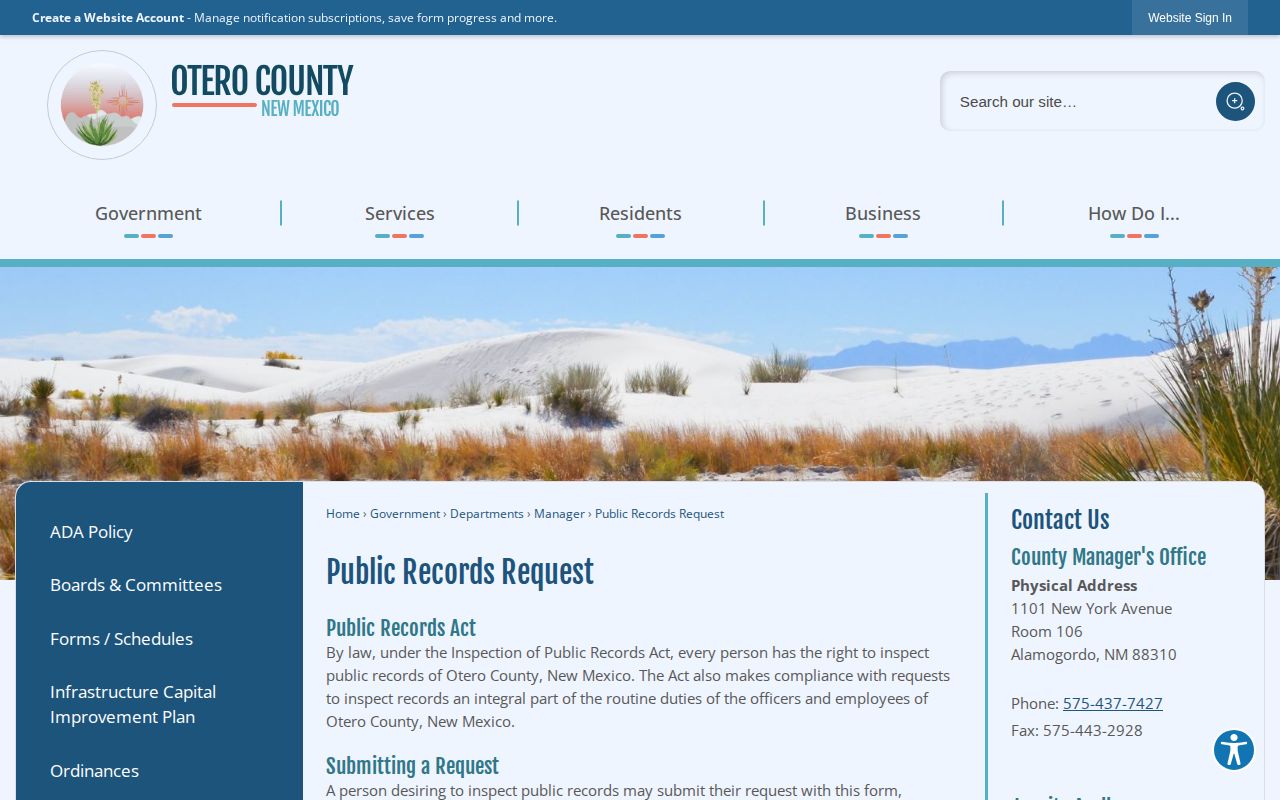
Ask the records custodian for the exact document you want. A specific request works far better than a name match or an unverified image floating around online. Precise requests also move faster, since the custodian knows just what to pull. Note: A city police department may hold the incident file instead of OCDC, in which case your request will be narrowed or redirected.
New Mexico Mugshot Access Rules
New Mexico public records run through the Inspection of Public Records Act. Otero County leans on NMSA §14-2-1. The written-request framework sits in §14-2-8. Nothing in IPRA forces a county to post booking photos online. No state statute makes Otero publish mugshots, and the county has no pay-to-remove law of its own. What you can get depends on the record, who holds it, lawful exceptions, and whether redaction applies.
Clearing a record is different. That takes a court process. The New Mexico Courts expungement information covers the Criminal Records Expungement Act, NMSA §29-3A-1, and the sections after it. Waiting periods and exclusions shift with the category of record. Expunged records are not destroyed, the courts note. They just stop showing up on public court, corrections, and law-enforcement sites once the process finishes.
Say a source is dismissed, sealed, expunged, or plainly wrong. Start with whoever holds it. The county IPRA custodian handles county-held records. The arresting agency controls its own file. The historical Otero page at Mugshots.com is a third-party archive, not an official feed, and its free correction process is publisher policy, not a promise. When a source page changes or comes down, Google and Bing cache-update tools can clear stale search results. Those tools never fix the source itself.
Note: A booking photograph taken at intake does not settle whether any particular copy is public, exempt, redacted, or still current.
Official Otero County Busted Lookup
Official Otero County busted information takes some digging. There is no county booking roster or mugshot search portal open to the public. So work the official sources in order. Start with the agency that made the arrest. An Alamogordo incident may show up in the city activity log. If someone may be held at OCDC, ask the jail about custody status and take the county records route for the actual file. A court record then shows how the charge stood after booking.
- Check the arresting agency's current official page or public log, if one exists.
- Confirm the jail or records custodian that maintains the relevant custody or booking file.
- Submit a focused IPRA request if no official online record answers the question.
- Use the court case search for later arraignment, release, dismissal, plea, or other disposition.
Warrant information is thin too. No sheriff's wanted list with names is published online. The Sheriff's Most Wanted page instead gives official tip lines and direct ways to verify a warrant yourself.
Where Otero Arrest Records Appear
Each channel captures a different moment. A city police log can show an event. A jail file covers custody. A court file follows the case after booking. Go to official sources first, since they name the record custodian, give context, and offer a way to fix errors. News stories and third-party sites can point you in the right direction. They just can't replace confirmation from the office that issued the record.
| Channel | Photo status | Official? | Best use |
|---|---|---|---|
| Otero County Detention Center and IPRA | Photo documented at intake; online display not located | Yes | Targeted booking-record or photo request. |
| Alamogordo Police activity logs | No public photo attachment established | Yes | Weekly major-activity arrest and incarceration lead. |
| Tularosa and Cloudcroft IPRA routes | No recurring city photo feed located | Yes | Incident or police-record request. |
| New Mexico Courts case lookup | Not a photo database | Yes | Case, court, and disposition follow-up. |
| NMCD offender search | No public photo promise reviewed | Yes | Later state-prison, parole, or probation status. |
| Mugshots.com Otero archive | Third-party historical copies | No | Unofficial lead only, then verify through the source agency. |
Third-party booking sites fall short here. RecentlyBooked and Arrests.org cover New Mexico counties. Neither offers a verified Otero section. The gap repeats at Mugshots.zone and Busted Newspaper, where no Otero page could be confirmed. A missing or stale page means little on its own, though. People get arrested in Otero County all the time, whether or not a commercial site posts about it.
Otero County Busted Jail Roster Facts
The county's own site map points to the Detention Center. It also lists inmate rules, mail procedures, bail, and related services. What you won't find is a public current-inmate search. There is no booking API and no searchable photo table. The inmate rules do describe what happens inside OCDC: booking, charge and bond notice, photography, and classification. Missing are a roster release schedule, an image-retention policy, or any rule about showing photos to the public.
So OCDC has no real online search field for a roster. The practical details below are what a requester can supply instead. They help locate a record the honest way, without pretending a portal exists.
| Request detail | Why it helps |
|---|---|
| Full name | Distinguishes the person from similar names. |
| Approximate arrest or booking date | Helps the custodian locate a custody window. |
| Arresting agency | Separates a city police file from an OCDC intake file. |
| Case or incident number | Connects the request to a specific event when available. |
| Record type | Lets the custodian identify a booking record, photograph, or incident report. |
The official Otero County Detention Center page is worth a visit. It explains how the facility runs. Just don't expect a live custody search there. None is offered.
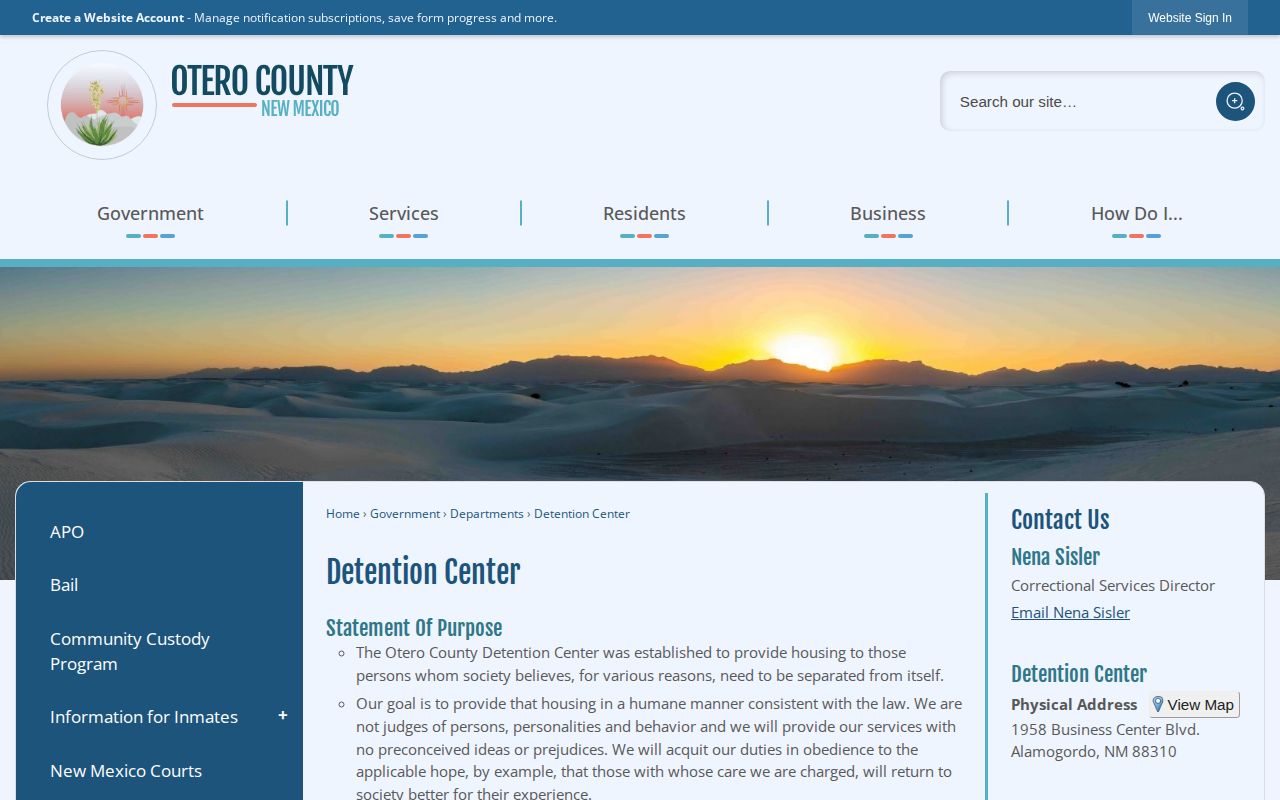
County sources describe a documented intake process in detail. A public roster is a different thing. None is posted for OCDC.
Note: NCIC inmate correspondence and county emergency alerts are communications services, not stand-ins for a current public jail roster.
Recent Otero County Booking Logs
Otero County has no same-day booking feed. The Sheriff's blotter page sounds promising. Mostly it holds old news items, including school notices from 2016. Think of it as an archive. Nothing there works as a current arrest log, and the county offers no weekly booking-photo feed either.
Alamogordo fills the gap. The city posts Police Activity Logs as weekly PDFs. Each one is dated and focused on major incidents rather than every call. A typical log lists case numbers, arrest and citation details, court references, releases on own recognizance, OCDC incarcerations, and unnamed juvenile referrals. That makes it a strong multi-day arrest index for the area. It is not an OCDC roster, though, and it does not confirm that booking photos are public.
Where to look: the official weekly activity-log index is the city source behind most Alamogordo arrest leads.
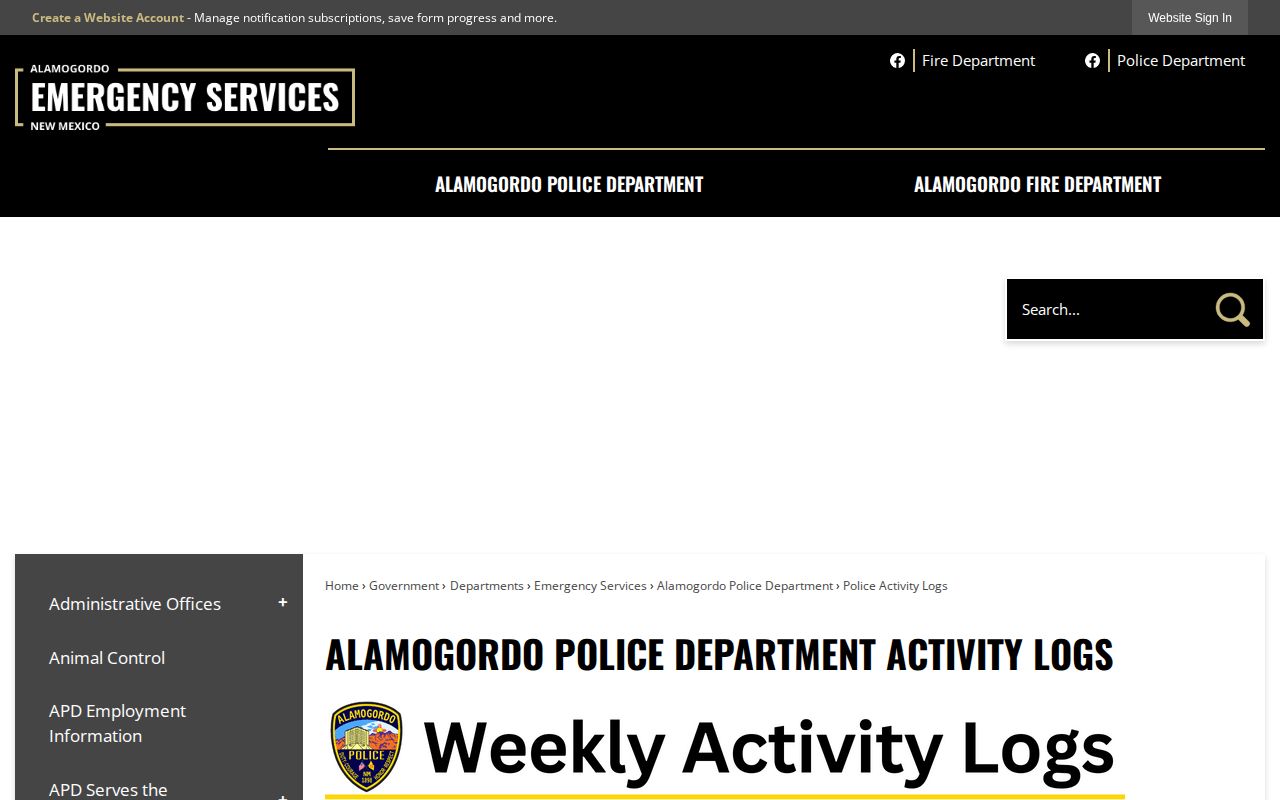
A weekly major-activity PDF can get you far. It may name an agency, a date, a case number, or a court reference. Need something deeper? Then the agency's records division is still the door to knock on.
Tularosa and Cloudcroft are different. Neither town posts a regular public arrest log, so their official IPRA forms and police contacts are the dependable fallback. To separate those documents from secondhand local coverage, see the Mugshots in the News page.
Otero County Busted Custody Alternatives
Custody systems overlap less than people assume. The New Mexico Corrections Department offender search covers state prison, probation, and parole. County and city jails sit outside its jurisdiction, per NMCD itself. A state hit can matter once someone has moved past OCDC, but it does not mean an Otero booking photo will surface there.
Once a booking lead exists, the New Mexico Courts case lookup can fill in the case history. Online result falls short? The Twelfth Judicial District's Otero court materials offer another route to copies. Court files show what happened after booking, like an arraignment, though they stand apart from the jail's own intake record.
Keep federal and immigration custody in separate lanes. The BOP locator tracks federal prison inmates. The ICE Online Detainee Locator handles civil immigration cases. Otero's ICE Processing Center carries its own documented federal contract and litigation history, so an ICE result is not a county criminal booking. VINE sends custody-status alerts but is not a photo search.
Otero County Arrests After Booking
A booking is one dot on a longer line. OCDC rules say charges and bond are explained at intake. Alamogordo activity logs may point to municipal, magistrate, or district court, so a single event can hop between agencies. Search the court file by name or case number. Confirm the court and case type. Then read the later outcome rather than leaning on the original charge.
| Status | Where to look | What it does not establish |
|---|---|---|
| Just arrested or booked | Arresting agency, OCDC, or a targeted county request | A final court outcome. |
| Released from county custody | Agency record and court case | That a jail roster still displays the person. |
| Sentenced or supervised by the state | NMCD offender search and NMCD records route | That NMCD holds the original OCDC photo. |
| Federal or ICE custody | BOP or ICE locator, as appropriate | That the person was booked into OCDC. |
Community data adds texture without acting like a live feed. A UNM community report counted 243 DWI arrests in 2024. Saturday brought the most arrests in that group. That figure is not a total-arrest count, a current roster, or a tally of available mugshots.
Note: A no-match in a court search can stem from timing, spelling, jurisdiction, sealing, or an incomplete search rather than a true absence of an arrest.
Otero County Busted Records and Archives
Being online and being retained are two different things. New Mexico's records schedule lists an adult jail inmate-file series slated for destruction five years after the file closes. That is not a promise that every Otero booking photo survives exactly five years in one format. What matters is the record series, its closure date, any transfer, and the schedule that applies. Ask OCDC which series holds the record. Ask whether it is active, archived, transferred, or destroyed.
For records that have actually transferred, the New Mexico Administrative Code retention rule and the State Records Center and Archives open a later research path. Archives access never bypasses an active county request. Expungement differs from destruction too. Justice agencies may keep an expunged record even as public web access changes through the court process.
Busted Mugshots by Otero County City
Records differ from city to city inside Otero County. Alamogordo has the strongest official online lead through its weekly major-activity logs. Tularosa and Cloudcroft offer documented police contacts and public-records forms, but no recurring official arrest-log page. In all three, the arresting agency's record may sit apart from the OCDC booking record.
- Alamogordo Busted Mugshots explains the weekly police-log route and its limits.
- Tularosa Busted Mugshots maps the village IPRA route and county booking destination.
- Cloudcroft Busted Mugshots separates village police, regional dispatch, records requests, and county custody.
A news item or third-party page can be a decent first clue. Still, the police department, OCDC, the county custodian, and the court remain the sources able to verify or correct a record.